
ART Network Portal Webinar Series – 2026
ART Webinar: Research Translation as a Systems Challenge: Insights from NSF’s Accelerating Research Translation (ART) Awardees
Presenters:
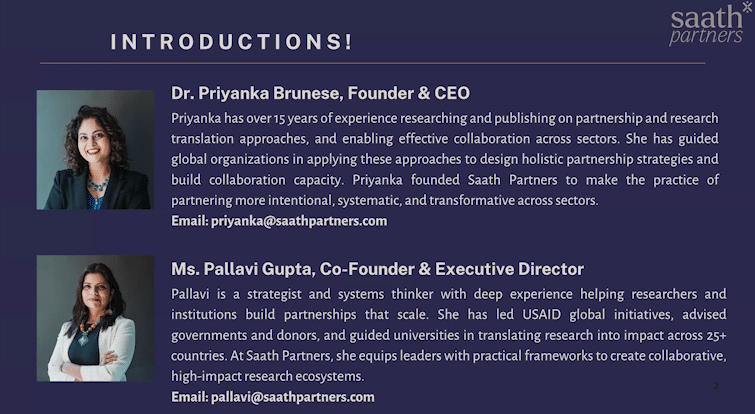
Pallavi Gupta, Saath Partners
Dr. Priyanka Brunese, Saath Partners
Date: Friday, October 30, 2026
Contact Email: pallavi@saathpartners.com; priyanka@saathpartners.com
Webinar summary
Quick recap
This webinar focused on research translation challenges, featuring a presentation by Pallavi Gupta and Priyanka Brunese from Saath Partners about their findings from interviews with 18 representatives across 12 ART awardee institutions. Framing effective research translation as research that is both use-inspired and use-ready, the presenters identified six key breakdowns in the research translation system: lack of shared definitions and frameworks, misaligned promotion and tenure incentives, limited capacity building opportunities, fragmented institutional support, limited infrastructure for multiple pathways to impact, and ad hoc involvement of partners. They highlighted how these breakdowns are interconnected and require holistic approaches rather than isolated solutions, drawing on their previous experience with USAID’s LASER PULSE program at Purdue University. The presenters emphasized the importance of addressing these system-level challenges simultaneously through approaches that tackle the system across five levels: mindset shift, capacity building, infrastructure development, legitimacy through metrics, and ecosystem-level support. The discussion included questions about expanding research translation and commercialization ecosystems to include other translational pathways and setting realistic expectations for time requirements in research translation processes.
Summary
ART Enhancement Program Overview
Atam Dhawan, Chief Strategic Innovation Officer and Senior VP of Research at New Jersey Institute of Technology, welcomed participants and discussed the ART Enhancement Program and ART Network Portal, which was developed to accelerate research and innovation translation to commercialization. He explained that the portal serves as a national platform connecting academic researchers, industry partners, students, postdocs, and investors to share experiences, resources, and technologies in various stages of development. Atam noted that the recent Track 5 ART award focuses on expanding this national community of practice to enhance innovation translation and tech transfer capabilities across stakeholders.
Introductions and USAID LASER PULSE Background
Pradeep introduced the webinar and thanked Iris and Michael for their contributions to the ART Portal network, highlighting the program’s successes over the past three years. He then introduced the main presenters, Pallavi and Priyanka, who shared their extensive experience in research translation and systems thinking, particularly from their work on the USAID LASER PULSE program. Pallavi explained how USAID made a strategic shift in 2012 to connect university research directly with societal impact through Higher Education Solutions Network (HESN) programming, leading to the creation of the LASER PULSE program in 2018, a consortium of Indiana University, Notre Dame, Makerere University and Catholic Relief Services, led by Purdue University. The program implemented 50 projects across 25 countries involving 45+ universities and built a network of 3,200+ members across 86 countries. Pallavi noted that this mission of translating research into societal impact is essentially the same as ART’s, with ART focused domestically. When USAID was deprioritized in 2025, Pallavi, the program’s director, and Priyanka, its research scientist, continued this work together under Saath Partners.
Conditions for Effective Research Translation
The presenters, Pallavi and Priyanka, framed effective research translation as the combination of two conditions: research that is use-inspired, informed by the people, contexts, needs and barriers it is meant to address, and research that is use-ready, prepared in formats and with the conditions and supports that make it usable and relevant. Drawing on a LASER PULSE literature review, they described a research translation continuum, from post-facto translation planned after the research is done to pro-active translation, where users are engaged from the start and translation is planned throughout. Because both partner engagement and planning for use depend on working with non-academic partners, they also highlighted collaborative inertia: partnerships that start with energy but slow down without mechanisms to assess and sustain them.
They then mapped the key actors in the research translation system (research funders, university leaders and departments, faculty and their teams, centers and institutes, support offices and intermediaries, and external partners, research users and networks) and noted the power dynamics that run across them.
Six Breakdowns in the Research Translation System
The presenters shared a systematic analysis of research translation challenges across universities, based on interviews with 18 representatives from 12 ART awardee institutions. These insights were complemented by Saath Partners’ own workshops and practice. They identified six key breakdowns in the research translation system: lack of shared definitions and frameworks, misaligned promotion and tenure incentives, insufficient capacity building for partnership skills, limited infrastructure for multiple pathways to impact, fragmented professional staff roles and institutional support, and late or ad hoc involvement of partners and research users. The presentation concluded with an interactive activity asking participants to identify which 2-3 breakdowns they experience in their settings. Misaligned promotion and tenure incentives drew the most responses, followed by late or ad hoc partner involvement, fragmented institutional support and limited capacity building. These key breakdowns in the research translation system are interconnected and reinforce a negative loop that results in research teams being less equipped to: develop proposals with diverse research translation strategies and impact pathways, translate research into use-ready and adaptable outputs and build sustainable partnerships based on shared value that lasts beyond the life of a single project.
Promising Initiatives and the Case for a Holistic Approach
Because the six breakdowns are interconnected, addressing them individually would not be very effective, so a coordinated approach is needed to tackle them together. The presenters then shared examples of promising initiatives by ART awardees addressing multiple breakdowns, such as translation academies, applied capacity building cohorts, and changes to promotion and tenure structures, noting that institutions may have made further progress since the interviews. They encouraged participants to reflect on how their initiatives tackle multiple breakdowns and not just a few.
A Holistic Approach in Practice: USAID’s LASER PULSE Program
LASER PULSE served as an example of a holistic approach. Rather than treating translation and partnership as add-ons, the program built translation and partnership into every phase, from setting the research agenda and calling for proposals to reviewing, implementing and sustaining projects beyond the award. Program-wide supports, including a shared language and results framework, a partner network, needs-based capacity development and continuous learning, connected these phases into one system. This integration led to research shaped by its users, stronger partnerships and proposals, and impact that lasted beyond individual projects.
Practical Starting Points and Tools
Drawing on the interviews and their practice, the presenters offered a five-level framework for designing holistic solutions (mindset shift, capacity building, research translation infrastructure, legitimacy and ecosystem) with example starting points at each level. They invited participants to consider whether their current initiatives connect across all five levels or sit in only one or two.
They also shared Saath Partners’ tools and support, which map onto the five levels:
- Mindset shift: Research Translation Compass, a self-assessment of how researchers engage partners and plan for use; Research Translation Pathways Guide, mapping major pathways to impact
- Capacity building: Strengthening Partnerships for Research Impact workshop, building hands-on skills for engaging partners and planning for use
- Infrastructure: Partnership Strategy Development workshop, for shared strategies in interdisciplinary proposals; Partnership Health Check tool, to spot partnership challenges early
- Legitimacy: Partnership and Research Use Indicators Guide, for documenting and recognizing translation contributions
- Ecosystem: Stakeholder-Driven Strategy Development and System Mapping Workshops, for aligning priorities and coordinating action
Q&A Highlights
Atam noted that translation is not linear: stakeholder involvement and ecosystem needs change across technology readiness levels, and teams need to stay flexible and expect the unexpected. Asked how a strong commercialization ecosystem could better include other pathways, the presenters suggested broadening technology transfer metrics and skills so offices can engage upstream with faculty, or creating a triage point that routes policy, practice and community work to the right support, along with co-creating metrics for those pathways with stakeholders. On setting realistic time expectations, Priyanka pointed to making the often invisible work of translation visible, and Pallavi described partnership building as a continuous practice, so relationships are already in place before a proposal deadline.
To follow up, contact Pallavi Gupta (pallavi@saathpartners.com) or Dr. Priyanka Brunese (priyanka@saathpartners.com), or visit saathpartners.com.
About the Presenters
Pallavi Gupta
Co-Founder and Executive Director, Saath Partners
Pallavi Gupta brings 17+ years of experience leading cross-sector partnerships that turn research into real-world impact. At Saath, she helps universities design strategies and structures that make collaboration work. She served as Chief of Party for two flagship USAID programs: LASER PULSE, a $70M research-for-development consortium that advanced research translation across 25+ countries and built a 3,200+ member network from 86+ countries, and ARC, a climate resilience initiative in Asia. At Purdue University, she directed the Shah Family Global Innovation Lab, leading technology commercialization and impact entrepreneurship. Earlier, she advised donors and governments on strategy with PwC in London and founded a nonprofit in India advancing economic inclusion through public-private-people partnerships. A former software engineer, Pallavi brings a systems-thinking lens to every engagement. She is an Ashoka and INK Fellow and served on a State Government Innovation Council in India. She holds a master’s in Management Information Systems from the London School of Economics and a master’s in International Development from Brandeis University.
Dr. Priyanka Brunese
Founder and CEO, Saath Partners
Dr. Priyanka Brunese is a strategist, pracademic and partnership designer with more than 15 years of experience at the intersection of research and organizational change. As research scientist for USAID’s LASER PULSE Consortium, she co-developed a research translation approach adopted by 50+ projects across 21 countries. She also led USAID-funded research on private sector engagement, turning insights from 60+ global interviews into practical toolkits. As Director of Research Development at Purdue University’s Honors College, she supported interdisciplinary research, internal grants and donor engagement. Her scholarship on collaborative inertia and academic-practitioner collaboration informs her evidence-based approach to partnering. As an AAAS ELISS Fellow, she facilitated cross-sector dialogue between local communities and national policy leaders. She has helped the Alliance of Bioversity International and CIAT strengthen their partnership approach and has worked with The Partnering Initiative. Priyanka holds a PhD in Organizational and Leadership Development and a master’s in Information Systems from Purdue University.